

👋 ASB Partners Nuggets
This is a short weekly email that covers a few things I’ve found interesting during the week.
Interesting Links/Reads
Many links are sourced from Marginal Revolution (bold and italics are my own to highlight what I found particularly interesting)
Podcast/Videos
h/t to Patently Jewish Torah Observant Jew + Patent Attorney
Show Notes are from Peter Attia
How finding one’s passion can cultivate perseverance and discipline [23:15]
James discussed grit with his friend David Epstein, and the question came up, what if this grit/ perseverance/ discipline is one’s natural propensity based on the thing they are working on?
If a person is highly interested in something, what are the chances they will have increased perseverance and discipline in that area?
“It’s very hard to beat the person who’s having fun because they’re going to want to keep working longer than the person who’s suffering, so grit is fit, I think is one way in which you can maybe try to stack the deck or stack the odds in your favor and get your genes aligned with the things that you’re working on” – James Clear
Not all of us are going to have the good fortune to discover whatever the thing is we are interested in and good at at 4 or 6 years old
Going back to the Michael Phelps example, he began swimming at age 7
It’s very hard to find someone who’s more optimally designed to move through the water than him
This doesn’t mean that one should stop searching for what they are good at and passionate about
A person who is curious and willing to explore a lot of things is more likely to come across an area where they are fascinated or they are interested, and it also is a really good fit for their natural abilities or propensities
From a genetic standpoint, anyone can improve but this doesn’t mean anyone can be Michael Phelps
Key point:
Find what is interesting so it doesn’t feel like suffering in the same way that other people feel when they are trying this thing
“You’ll often be surprised how far you can go and how willing you are to build habits and improve skills if you find some of those things that you’re truly fascinated by” – James Clear
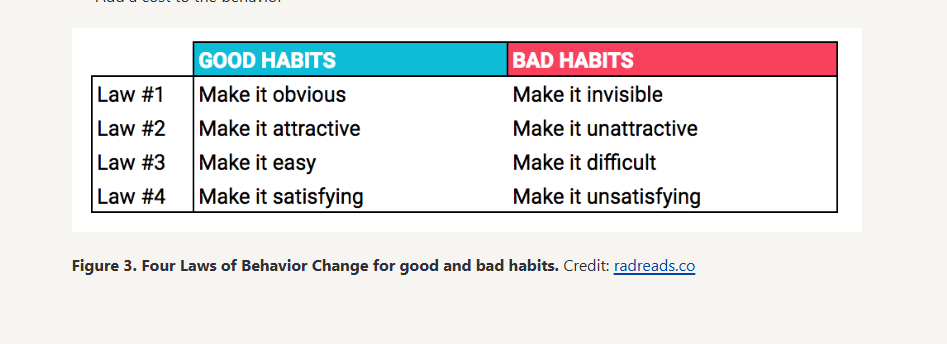
The Four Laws of Behavior Change: How to apply the 4 steps of a behavior (cue, craving, response, and reward) to the creation of a new habit
1—Make it obvious
Make the cues of a good habit easy to see, the easier they get one’s attention the more likely one is to act on them
2—Make it attractive
The more appealing or exciting a habit is, the more likely one is going to feel motivated to do it
The more something is anticipated, the more motivation one will feel to do it
3—Make it easy
The more convenient and simple a habit is, the more likely the behavior is to be performed
4—Make it satisfying
The more enjoyable or pleasurable a habit is, the more likely one is to repeat it in the future
These 4 laws give a high-level overview of how to build a good habit
It doesn’t require all 4 every single time, but the more of the 4 there are, the more likely it is that the good behavior will stick
Using more of the 4 also makes it more likely that one will start on the new habit
I hope you enjoyed it.
Adam