

👋 ASB Partners Nuggets
This is a short weekly email that covers a few things I’ve found interesting during the week.
Quote of the Week
"Don’t try to buy at the bottom and sell at the top. It can't be done except by liars.” Bernard Baruch
Interesting Links/Reads
Many links are sourced from Marginal Revolution (bold and italics are my own to highlight what I found particularly interesting)
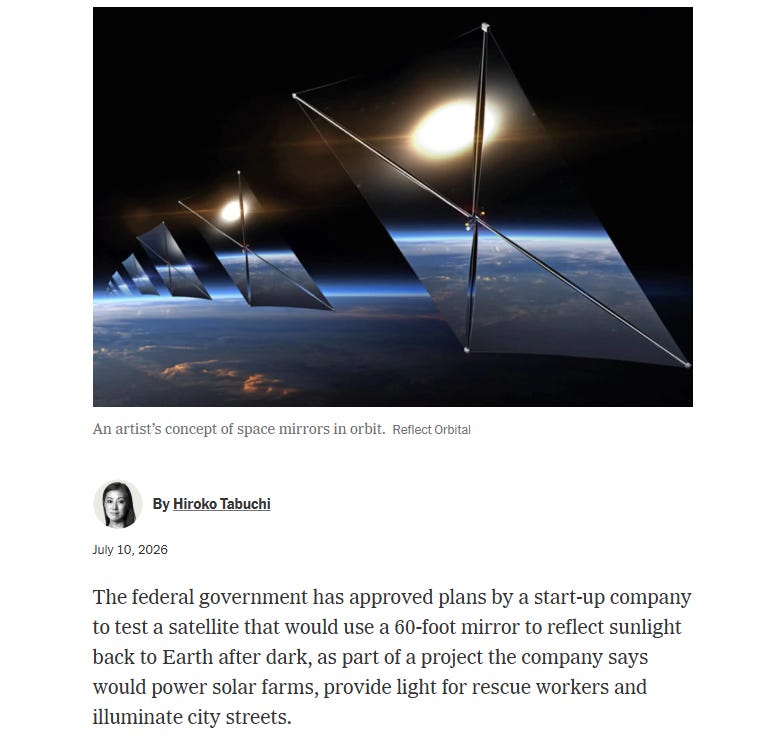
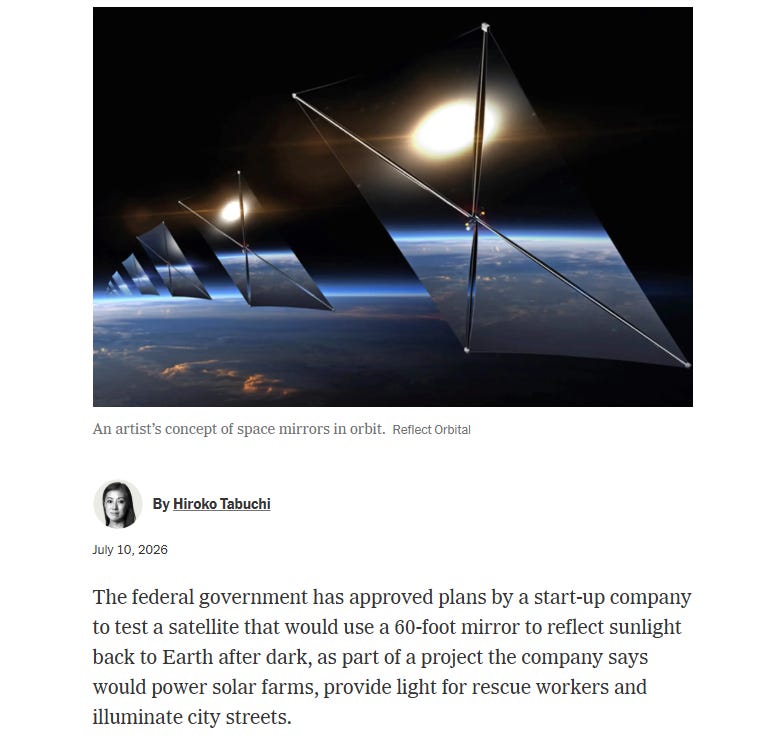
Roughly the size of a dorm fridge, Reflect Orbital’s first prototype, once in space about 400 miles up, would unfurl a square mirror nearly 60 feet wide. The mirror would bounce sunlight to illuminate a circular patch about three miles wide on the Earth’s surface.
Reflect Orbital hopes to launch 1,000 larger satellites by the end of 2028, and 5,000 others by 2030. The largest mirrors are planned to be nearly 180 feet wide, reflecting as much light as 100 full moons.
The Most Efficient Market Why doesn't everyone index US large caps? Dan Rasmussen from Verdad
In our piece, “Where Factors Speak Loudest,” we showed that the strength of factor premia is size-dependent. Value, quality, and other signals are strongest in microcaps and small caps and get progressively weaker as you move up the market-cap spectrum. The biggest stocks are, in a very real sense, the least mispriced. That is exactly what you would expect if US large caps are the most efficient market in the world. The place where factors speak the quietest should also be the place where active managers have the hardest time earning alpha. And that is exactly what the active-management data show.
My mental model is simple: alpha is a function of neglect. The more liquid, researched, benchmarked, and institutionally trafficked a market becomes, the harder it is for active managers to earn excess returns after fees. The opposite is true in smaller, less liquid, less intermediated markets.
Japanese small caps are one example. Over the 10 years through 2025, 38% of Japanese mid-and small-cap funds beat their benchmark. That is hardly a free lunch—most still lost—but it is a much better starting point than the 3.6% success rate in US large growth or the 8.1% rate in US large blend.
3.The Best Time to Beat the S&P 500 in History
We believe the next several years will be the best environment in modern S&P 500 history for fundamental active managers¹ to beat the index. The setup is extraordinary, and it will likely last only a few years before the index organically corrects for today’s Mag 7 imbalance. The S&P 500 is now highly concentrated in a coterie of richly valued mega-cap technology companies at the exact moment those companies are being forced into an existential AI arms race. The scale of the buildout is becoming so immense that historically cash-rich hyperscalers are starting to dilute shareholders to fund it. Google recently raised $85 billion through an equity offering to expand its AI infrastructure, while Oracle raised $5 billion of equity with a further $20 billion on the way. This is not to mention the aggressive tapping of debt markets—GOOG, AMZN, META, ORCL, NVDA & SPCX have issued ~$224B in bonds YTD, already double all of 2025’s $108B². The largest companies in the index are committing ~all of their free cash flow and more, roughly $750 billion in expected AI-related spending in 2026 (about $150 billion more than expected at the start of the year), to build the infrastructure layer for the next phase of the economy.

Now, a new study published on Wednesday in the journal Science Advances reveals that the space rock is no ordinary specimen. It contains complex organic molecules and tantalizing evidence of salty water — ingredients that life, as we know it, thrives on. Asteroids much like the Hillsborough sample may have delivered the same crucial compounds to a newly-formed Earth billions of years ago.
5.The future belongs to AI maniacs by Tyler Cowen July 17, 2026
That is the theme of my latest Free Press column, excerpt:
An AI maniac is someone who is obsessed with working with the latest AI models. They try out new models as soon as they can, they spend hours and hours trying to master them, and they use them to regulate both their workflows and their personal lives. I know one person who has his AI agent text him if he is not drinking enough water, for which he’s placed cameras around his house. One online anecdote tells of a man who canceled a date to spend more time playing around with Claude Fable 5 after Anthropic (where I am a member of the economic advisory board) extended the model’s availability for a few days.
Many AI maniacs are using AI tools to start companies of smaller size, and thus of smaller expense, than ever before. For those companies, the humans must set in motion and then monitor a large number of AI tools and agents. Those individuals then stand to reap outsize profits as their companies grow and succeed. Stripe, the payments company, recently issued customer data showing that the number of single-person companies earning $10 million or more has doubled in the past two years. There is no firm estimate how much of that improvement is due to AI, but it stands to reason that AI is a main driver of the trend…
Anecdotally, I observe that AI maniacs tend to be young, as with participants in so many other cultural trends. They tend to lack standard manners and graces, as they just want to “get right to it.” They are able to imagine a future that is very different from our present. Many of them also are kind, as they see the potential for new AI services, in areas such as biomedicine, to help other people. Their obsessiveness is a small price to pay for all of those virtues, and it is usually part of their charm and vibe.
The AI maniacs also are skeptical of credentials, as they should be. If you wish to learn how to manipulate AI tools, Harvard and Yale are not the places to go. You need to teach yourself, with assistance from other AI maniacs and also with help from the AI tools themselves. There are some AI maniacs in the Ivy League, but too often those individuals have invested their energies into other, more established ways to succeed.
I also believe that immigrants are especially likely to be AI maniacs. Immigrants have fewer channels to rise through credentials, family connections, and establishment modes of thinking and doing. They are more willing to try something new, they tend to be younger than average, and, because they were willing to switch countries, they tend to have higher levels of energy, courage, and ambition.
Worth a ponder.
Podcasts/Videos I’ve watched during the week
Winston Aubrey Aladar Marshall was born in Wandsworth, London, on 20 December 1987.[1][a] He has a sister Giovanna who is a singer and songwriter.[2] His father is Paul Marshall, a British hedge fund manager who co-founded the Marshall Wace hedge fund and is the co-owner of GB News.[3] His mother, Sabina de Balkany,[4] is French[5] and comes from a genteel European Jewish family.[6]
His maternal grandmother was novelist and property developer Molly de Balkany [fr],[7] who was one of the first female property developers in France,[8] and his maternal great-uncle was the collector Robert Zellinger de Balkany [fr].[9][10] Molly and Robert’s family relocated to France after World War II,[11] where they added the nobiliary particle “de” to their name despite that they had not been ennobled.[12] Marshall has said that 13 members of his family “were murdered in [...] the Holocaust“ of which his maternal grandmother was a survivor.[6][13]
👇Very interesting for anyone who is a practicing lawyer or uses legal services. This seems to be one of the leading AI companies attacking the 1 Trillion dollar industry…Legora has 50% quarter over quarter growth for the last seven quarters!….
34:25
It’s a trillion dollars every year into legal services, which is very fragmented.
But the software spend into legal technology is about 40 billion.
So it means there’s 4% software, 96% service, which is bananas.
34:41
The software piece should be much bigger than that.
And so the software piece naturally will grow into the service revenue.
But also legal is a very supply constrained market.
The demand for legal services is much larger than what there are lawyers or legal services available.
Kirkland earns around $10 billion a year.
38:14
Speaker 1
How many lawyers do they have?
38:15
Speaker 3
4 or 5000, wow.
I mean per partner, they make it between 5 and 10 million every year in profits.
And so when something like AI comes along, that poses existential threats and existential opportunity.
38:32
And that’s actually a big part of my job to help articulate with the leadership teams that we work with because we will only be as successful as our customers are.
This is very strange in the US, but Westlaw basically has a monopoly with the American government to report on the cases.
So they’re not owned by the public in a way, they’re owned by the company.
45:39
Speaker 3
They’re trying, they’re trying.
That’s it doesn’t work.
Or rather put it this way, you cannot build a legal research solution that doesn’t have all of the data.
Because if you go to Woktel and a litigator at Woktel, the best law firm in the world says, I’m going to use this to, to, you know, go after Elon or, or do a billion dollar case, you better make sure you have all the cases.
46:05
Speaker 1
So.
So it’s the opposite of the power law.
You don’t just need the top 80%, you actually need all of it.
46:11
Speaker 3
All of it.
46:12
Speaker 1
Which means you have to go to courthouses and ask them for a copy to print it out and pay them $0.10 a page.
46:18
Speaker 3
Well, there’s other ways of getting it, but in in practice, yes, you have to physically get the books all the way to India.
You need to open them, you need to scan them because you need to get what’s called page citations.
I never thought in in college I would get this nerdy about legal data, but here we are.
46:38
And what’s interesting is that these previous generation of databases were very much search in the database, find the case and then the lawyer you know does their work.
46:50
Speaker 1
Right.
46:51
Speaker 3
What’s really interesting about especially the agents following the release of Opus 4.5 and 4.6 is they can now start to do really intelligent case strategy and they can actually start to combine the witness statements, the cases, and they can really do end to end work.
47:12
Which is I think moving us from a world where AI is just augmenting to AI is actually really doing things.
And your job becomes to orchestrate and to manage those agents, as we’re seeing in coding.
I hope you enjoyed it.
Adam