

👋 ASB Partners Nuggets
This is a short weekly email that covers a few things I’ve found interesting during the week.
Quote of the Week

Interesting Links/Reads
Many links are sourced from Marginal Revolution (bold and italics are my own to highlight what I found particularly interesting)
Those new service sector jobs -- "One nanny isn’t cutting it anymore. Some parents are spending upward of $250,000 on teams for their children. Luxury services offer potty-training, baby chefs and bike-riding lessons." (WSJ).
Too Small to Matter? Public microcaps are trading at massive discounts
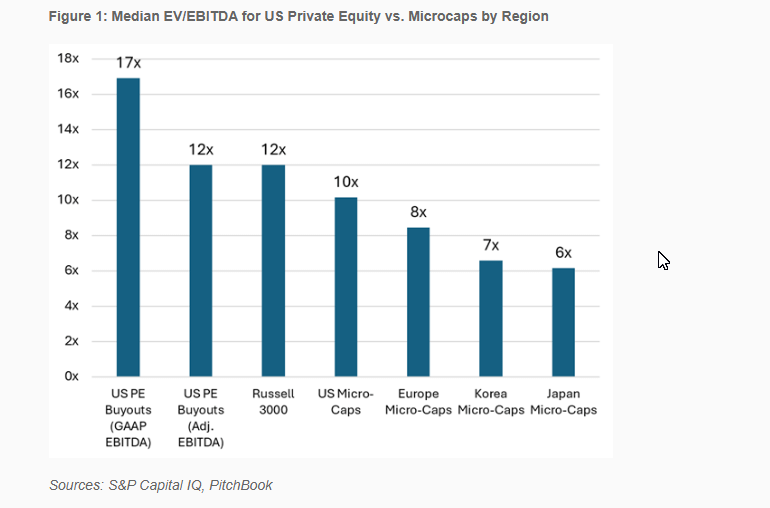
Private equity trades somewhere between a 0% and 40% premium to public markets, depending on how you account for EBITDA add-backs. US microcaps trade at about a 20% discount, European microcaps at about a 30% discount, Korean microcaps at about a 40% discount, and Japanese microcaps at about a 50% discount to the broad US equity market.
We believe investor neglect, not bad financial performance, has driven the wide valuation discounts in public microcaps. This neglect is easy to observe: How many friends do you know who work in private equity? How many friends do you have who work in small or microcap public equity investing? When was the last time your investment committee got excited about a one-off co-investment? OK, now when was the last time they agreed to directly allocate capital to a single-name microcap public equity? How many pitches per day does your RIA receive from private equity? How many from microcap public equity managers?
Investors broadly agree that smaller companies offer greater opportunity for skilled investors. Then they crowd into the most competitive market for owning them. The smallest public companies remain unusually cheap not because investors have rejected the idea that smaller companies are attractive but because they have chosen to pursue those companies exclusively through private equity.
3.Betting markets in everything

Alan and Karen Miller’s first dance was a win-or-lose moment for many of their wedding guests.
As the couple glided across the floor during their reception in New Rochelle, N.Y., last year, attendees kept track of the chosen artist and the length of the dance. Earlier in the night, they had noted their guesses on prop bet sheets.
Proposition, or prop, bets are usually tied to sporting events. Users place wagers on specific details that aren’t necessarily correlated with a game’s outcome, like points scored by certain players. Now, these bets have entered the world of weddings.
More couples have been integrating betting into their celebrations in recent years through digital apps or printed cards. While the Millers, who live in New York City, aren’t avid sports bettors or gamblers themselves, they wanted to make their June 2025 celebration more interactive and distinctive for their 175 guests.
“I’ve been to many New York and New Jersey weddings, and sometimes I feel like for cocktail hour, it kind of has a little bit of a lull, even though there’s a lot of good food,” said Karen, 38. “We wanted to make sure our guests had an activity that a lot of people could partake in.”
She bought a prop bet template from Etsy and customized it on the graphic design platform Canva. Among the questions on the couple’s prop bet sheet: Who will give the longest toast? Will the couple cry during the speeches? How many outfits will the bride wear on the wedding day?
…“If the groom’s known to be an emotional man, it’s fun to bet on how early in the day he’s going to cry,” Drachenberg said. “I think it engages them a bit more in the day.”
Here is more from Ellen O’Brien at the NYT. Supposedly more than 25,000 couples have attempted some version of this on the app.
Something that the Ukraine and Iran wars have taught me is that for a lot of countries, including very big countries, there are a small number of buildings and infrastructure components that are required for their economy to function.
And in countries that aren’t protected by oceans, like the US, drones completely change everything.
You can just make a list of oil refineries and production plants and the infrastructure around their main exports, and you can just attack them and destroy them and take them off the list.
4 years ago I would have thought there are too many of these components and they’re too easy to recreate, but both of these collisions have taught me that there are far fewer and that many of them will take years, if not over a decade, to rebuild.
It’s very strange to me that drones can now effectively harm the economy of a country.
That is from Daniel Miessler. While I am glad Russia is on the receiving end of this right now, this is arguably our biggest pending problem, bigger than what people typically refer to as AI risk.
Podcasts/Videos I’ve watched during the week
👇Mark Cuban's early 2000s Yahoo collar trade has to go down as one the most asymmetric ever
I hope you enjoyed it.
Adam