

👋 ASB Partners Nuggets
This is a short weekly email that covers a few things I’ve found interesting during the week.
Interesting Links/Reads
Many links are sourced from Marginal Revolution (bold and italics are my own to highlight what I found particularly interesting)
At the center of the Kazakhstan deal is an Australia-born rabbi named Pini Althaus, who moved to the United States years ago and set his sights on critical minerals.
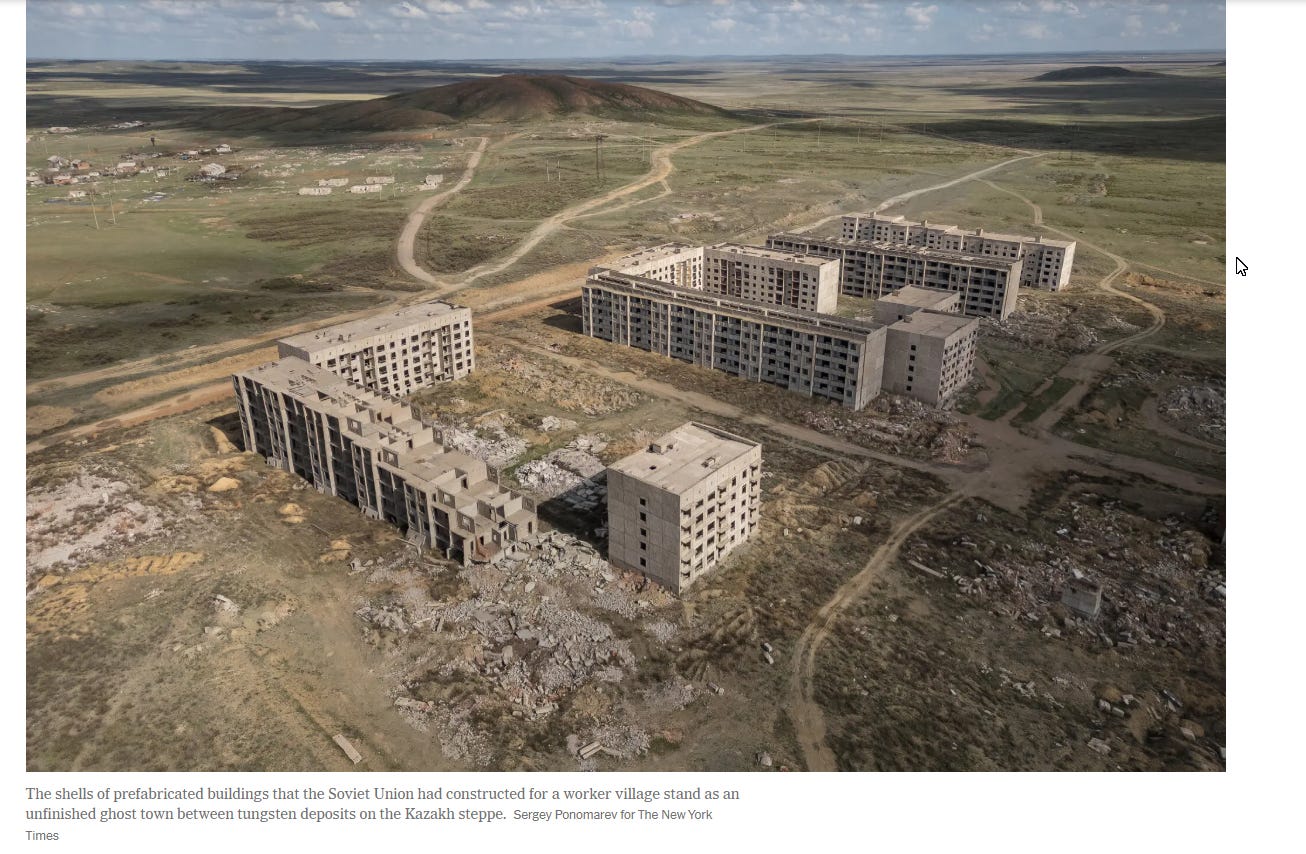
Here, outside the village of Unrek, population 407, the little lakes mark the places where the Soviet Union dug holes to prospect for tungsten.
With its exceptional hardness, density and high melting point, tungsten became known as the “war metal,” with key uses in munitions, aviation and weapons.
The Soviet Union’s collapse interrupted its plans for new mines in Kazakhstan, a former Soviet republic. Tungsten mining in the United States also petered out, with the last operating U.S. mine, in Utah, ceasing production about a decade ago.
Since Mr. Trump returned to office, the federal government has given conditional or final approval to 60 critical minerals projects worldwide backed by $18.6 billion in federal loans, loan guarantees or other financing, according to a count in May by BMO Capital Markets, a leading bank in the sector. That is the largest amount in U.S. history, a bank executive said.
That project will require a huge investment, which Mr. Althaus estimates will total about $650 million initially and $1.1 billion over the life of the project. According to his firm’s own calculations, the tungsten there might be worth as much as $80 billion.
His company could not make the project happen by itself. He needed the U.S. government to cut a deal with Kazakhstan at the highest levels, and to pledge financing to make the math work. In return, the United States could get access to an estimated 12,000 metric tons of tungsten a year, about as much as is now imported annually.
2.What America Gave the Jews — and What It Can Never Give ;What enabled Torah Judaism to flourish in America? Rabbi Ahron Lopiansky
Indeed, most people do not really believe that hard work is a necessary part of life. They equate less work and more leisure with less stress and more pleasure. But a common phenomenon belies this assumption. People work hard all their lives, saving up for their longed-for retirement. Then as the day approaches, they begin to panic: “What am I going to do with myself all day?”
A whole leisure industry has arisen to provide activities for people who no longer have productive work to do. Most of these leisure activities simply fill time and provide socialization, but they do not offer real fulfillment. Is this truly the freedom that people relish?
The answer lies in a deeper understanding of the human condition. Man is first and foremost a package of potential. At his core, he desires the opportunity to actualize that potential. Our lives are the time period Hashem has allotted us to accomplish that goal.
Indeed, man is created to work hard to bring out that potential. According to the Torah’s standards, sitting back and doing nothing is simply not living. Even by psychological standards, such a lifestyle is a recipe for mental distress. Just as our body feels fatigued when we’re in a state of inertia, likewise our soul suffers when we are not striving. Without realizing our potential, we’re unfulfilled and restless. Being Hashem’s servant does not mean that He needs our services. It means that we need to devote ourselves to bringing out the Divine from within
This is what makes slavery such a terrible misfortune. The worst state of being is when a person is forced to realize someone else’s goals and desires. His accomplishments are not his own, and his potential is subverted to someone else’s. So being freed from that kind of slavery really is an extraordinary blessing. Once a person has achieved that first step, he is then free to harness himself to activities that will bring out his unique, G-d-given potential. At that point, he is living a truly fulfilling life
3.How to ask for help from a stranger
The next heuristic is to make your request easy to accept. Making something easy to accept largely is about reducing the cost of acceptance. One clear kind of cost is the magnitude. Do ask someone for twenty minutes of their time, but don’t ask them to read your five-hundred-page manuscript in a week. Another is to make it specific: asking for a resource to start with is better than “can I pick your brain?”. When you’ve made your request, make it low friction for them. If you’re asking for an introduction, write a blurb about yourself which they can forward. If you have a question, ask it in writing rather than over a call. And last on cost, make your ask bounded. Don’t ask for recurring obligations like being your mentor for your whole life, but do keep it limited to asking them to read a blog post. If that instance goes well, they’ll gladly read more.
My last heuristic is stranger: make it easy to say no. You might think that the worst outcome is a no, but the worst outcome is a pressured, begrudging yes. Your coercion will have poisoned your relationship with this person while you feel the false glow of a hard-won victory. A person who helps you with gritted teeth is one who will never help you again. And even then, the help will be a half-hearted effort to get rid of the obligation you manufactured. By contrast, help freely given is effortless, the way you’d hold the door open for someone. Help willingly given keeps your conscience clear, free from the burden of having pressured someone. And help, when given from the heart, is the foundation of a relationship where both of you contribute to what you’re building.
Here is more from Pradyumna Prasad.
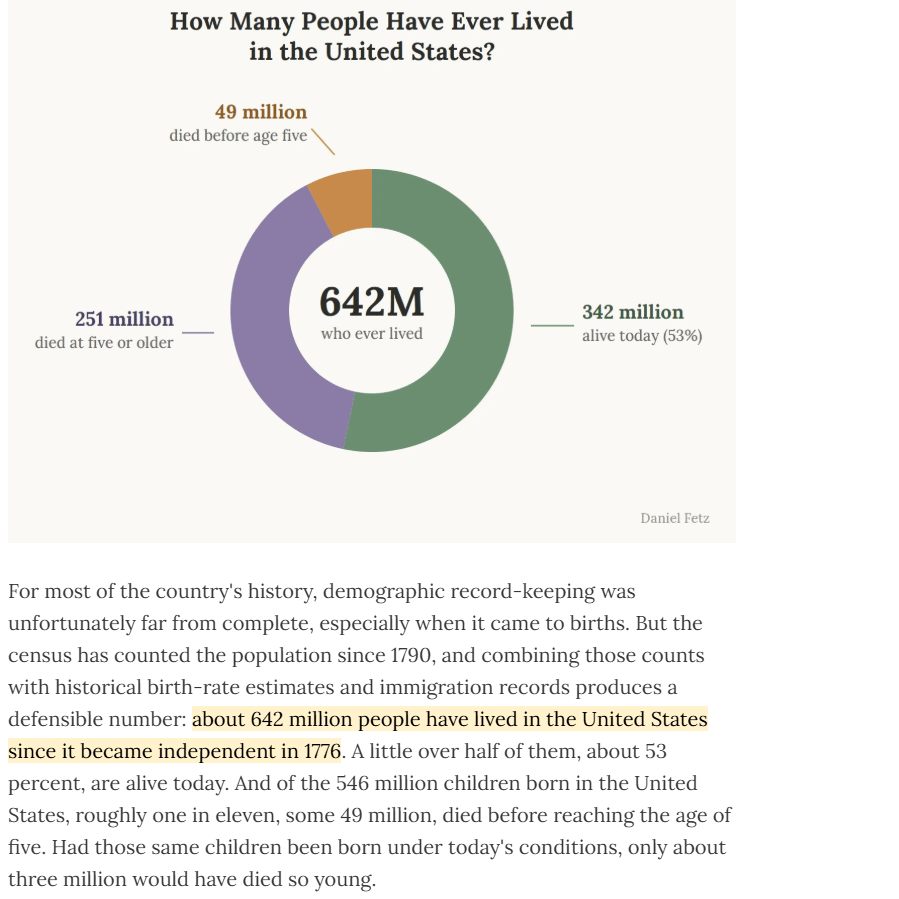
4.. How many people have ever lived in the United States? And what percentage of them are living here now?
In 1991 he was given a Grammy Lifetime Achievement Award, performed a nearly-unrecognizable version of “Masters of War,” took the stage sweating and fidgeting next to a grinning Jack Nicholson, and gave a strange oration:
Well, my daddy he didn’t leave me too much, you know, he was a very simple man, and he didn’t leave me a lot, but what he did tell me was this—he said so many things, you know. He did say, “Son, you know it’s possible to become so defiled in this world that your own father and mother will abandon you. And if that happens, God will always believe in your ability to mend your own ways.” Thank you…
Something happened to him on stage in Locarno, Switzerland. In Chronicles, he is almost comically vague about the nature of this revelation, but a 1997 Newsweek interview offers slightly more clarity. He was standing on stage when everything seemed to suddenly drop out.
It’s almost like I heard it as a voice. It wasn’t like it was even me thinking it. “I’m determined to stand, whether God will deliver me or not.” And all of a sudden everything just exploded. It exploded every which way. [...] After that is when I sort of knew: I’ve got to go out and play these songs. That’s just what I must do.
There were two other revelations that same year: one came while watching a jazz singer in San Francisco, the other had to do with a kabbalistically complex new guitar technique based on the number three, both of which are discussed in Chronicles with the same sense of vague awe, rushes of feeling that can’t be explained.
Podcasts/Videos I’ve watched during the week
👇Fascinating story about how Susquehanna might have potentially outfoxed Chinese insider traders
I hope you enjoyed it.
Adam